More companies are building with AI than ever before, and that surge in adoption is creating downstream demand for the infrastructure to actually run these workloads. According to DigitalOcean’s February 2026 Currents report, the percentage of companies actively implementing AI solutions, optimizing performance, or treating AI as a core part of their business strategy has grown to 52%, up from 35% in 2024. That growth means more teams need access to GPU clusters—and the market has responded accordingly. Legacy cloud providers like AWS, Azure, and Google Cloud have all bolted AI-specific compute tiers onto their existing platforms, while a new class of inference-focused providers has emerged to compete specifically on serving-time performance and cost.
But not all GPU infrastructure is created equal, and raw availability alone doesn’t solve the problem. Whether you’re serving a fine-tuned LLM behind a low-latency API, running batch inference over millions of embeddings for a RAG pipeline, or orchestrating agentic workflows with tool calls and human-approval checkpoints, your compute requirements will look different at each layer of the stack. The real challenge—and where provider selection matters most—is everything that surrounds the GPU: networking, storage I/O, autoscaling, cost predictability, and how tightly those pieces integrate. With 49% of developers identifying the high cost of inference at scale as the top blocker to scaling AI, choosing the right infrastructure partner isn’t just a technical decision—it’s a business one. Read on for a rundown of AI infrastructure companies to help you evaluate what matters for your workload.
Key takeaways:
-
AI infrastructure platforms provide the specialized GPU compute, storage, and networking needed to train, fine-tune, and deploy machine learning models at scale, replacing general-purpose cloud setups that can’t keep pace with the throughput and latency demands of modern AI workloads.
-
Purpose-built GPU infrastructure helps teams move faster from experimentation to production by simplifying provisioning, reducing scaling bottlenecks, and offering pricing models that make it feasible to iterate without overcommitting resources.
-
When evaluating providers, prioritize GPU availability and hardware options, scaling flexibility (single-instance vs. multi-node clusters), pricing transparency, and ecosystem compatibility with your existing frameworks and orchestration tools.
-
Leading AI infrastructure companies include DigitalOcean, CoreWeave, RunPod, Lambda Labs, Crusoe Cloud, Hyperstack, TensorDock, Voltage Park, Vast.ai, and Together.ai—spanning dedicated cloud GPU providers, decentralized marketplaces, and cluster-scale training platforms.
What is AI infrastructure?
AI infrastructure refers to the specialized hardware, software, and networking systems that power machine learning workflows—from model training and fine-tuning to production inference. At its core, that means GPUs and AI accelerators capable of handling the parallel computation that deep learning demands. But it also includes high-speed storage for managing large datasets, low-latency interconnects for multi-GPU synchronization, and the software stack (frameworks like PyTorch, orchestration tools like Kubernetes) that ties it all together. The right infrastructure directly affects how fast you can train models, how efficiently you can serve them, and how much it all costs.
How to assess an AI infrastructure provider
Choosing the right AI infrastructure provider involves striking a balance between performance, cost, flexibility, and ecosystem integration:
-
Hardware availability and performance: Look for access to modern GPUs and AI accelerators, such as NVIDIA H100s, AMD MI300X, or Google TPUv5. The specific hardware a provider offers determines the types of workloads you can run efficiently, from large-scale training to real-time inference.
-
Scalability and multi-GPU orchestration: Evaluate how easily you can scale workloads horizontally across multiple GPUs or nodes. Providers differ significantly in whether they support single-instance scaling, multi-node clusters, or full distributed training environments.
-
Cost transparency and flexibility: Check for on-demand vs. reserved pricing, spot instance options, and per-second billing. Hidden costs around egress, storage, and networking can add up fast, so look for providers that make the total cost of ownership easy to predict.
-
Developer ecosystem and integrations: Assess API support, SDKs, and compatibility with tools like Hugging Face, MLflow, or Modal. A strong developer ecosystem reduces onboarding time and makes it easier to plug GPU infrastructure into your existing ML workflows.
-
Support and operational reliability: Consider the quality of documentation, responsiveness of support, and uptime guarantees. When a training job fails at 3AM or GPU availability drops unexpectedly, the provider’s support infrastructure matters just as much as the hardware itself.
Top 10 AI infrastructure companies
From managing high-performance GPU clusters to delivering optimized inference APIs, AI infrastructure companies are reshaping how teams train, fine-tune, and deploy machine learning models. Here’s a closer look at 10 AI infrastructure companies worth evaluating—what they offer, what they cost, and where they fit:
Pricing and feature information in this article are based on publicly available documentation as of February 2026 and may vary by region and workload. For the most current pricing and availability, please refer to each provider’s official documentation.
*This “best for” information reflects an opinion based solely on publicly available third-party commentary and user experiences shared in public forums. It does not constitute verified facts, comprehensive data, or a definitive assessment of the service.
| Providers | Best for* | Standout features | Pricing |
|---|---|---|---|
| DigitalOcean | Production AI workloads and scalable GPU infrastructure | AMD MI300X/MI325X and NVIDIA H100/H200/L40S options; single and 8-GPU configurations; Kubernetes compatibility; predictable pricing and fast provisioning | H100: $1.49/GPU/hour<br>On-demand H200: $3.44/GPU/hour<br>Bare Metal: contract based |
| CoreWeave | GPU-intensive training and inference workloads | NVIDIA H100/A100 GPUs, Kubernetes-native scaling | On-demand HGX H100: $49.24/hour |
| Runpod | Community-driven AI workloads | GPU sharing, portable pods, serverless inference | Community cloud H200: $3.59/hour (80 GB instance) |
| Lambda Labs | Affordable GPU cloud for training | Dedicated GPU clusters, on-prem options | H100: $2.69/GPU/hr |
| Crusoe Cloud | Foundation model training | Dedicated cluster-scale NVIDIA H100/H200 deployments; contiguous GPU allocation within a single fabric; AI-optimized east-west network architecture; energy-optimized data centers powered by stranded/clean energy sources | NVIDIA H100 80GB: $3.90/GPU/hour<br>NVIDIA H200 141GB: $4.29/GPU/hour |
| Hyperstack | Dedicated GPU capacity for AI training | Capacity-first GPU allocation; bare metal provisioning; lifecycle transparency; H100/H200 availability | NVIDIA H100 SMX: $2.40/hour (80GB VRAM)<br>NVIDIA H100: $1.90/hour<br>NVIDIA H200 SMX: $3.50/hour (141GB VRAM) |
| TensorDock | Marketplace-based dedicated GPU servers | Multi-operator aggregation; customizable hardware configurations; decentralized supply elasticity | Enterprise GPU H100: $1.99/hour<br>Workstation RTX GPUs: $0.20–$1.15/hour |
| Voltage Park | Distributed GPU clusters for foundation model training | Pre-assembled multi-node clusters; minimal GPU fragmentation; sustained training optimization | On-demand H100: $1.99/hour |
| Vast.ai | Decentralized GPU marketplace access | Bidding marketplace; host reliability scoring; real-time supply-demand pricing | H100 SXM: $1.87/hour (P25)<br>H200: $2.35/hour (P25) |
| Together.ai | High-performance LLM training and inference | Rack-scale GPU systems; large distributed clusters | H100 SXM: $2.99/GPU/hour |
1. DigitalOcean with robust support for production AI workloads and scalable GPU infrastructure
DigitalOcean has spent over a decade making cloud infrastructure more accessible for developers and growing businesses—stripping away the complexity that slows teams down and replacing it with straightforward tooling, transparent pricing, and fast provisioning. That same philosophy now extends to AI. Rather than forcing teams to navigate hyperscaler complexity or stitch together fragmented GPU services, DigitalOcean provides a full-stack cloud platform where AI workloads—particularly production inference—are treated as first-class operations, not afterthoughts bolted onto training-first infrastructure.
GPU Droplets offer on-demand, virtualized GPU instances for training, fine-tuning, and deploying machine learning models without quota approvals or long provisioning cycles. The platform supports AMD Instinct MI300X and MI325X alongside NVIDIA H100, H200, L40S, and RTX Ada GPUs in single- and 8-GPU configurations. GPU Droplets are compatible with Kubernetes and containerized workloads, with built-in monitoring and alerting for visibility into instance health and performance. For teams scaling from experimentation to production, GPU Droplets support both vertical scaling to larger configurations and horizontal scaling across multiple instances.
Bare Metal GPU servers deliver dedicated 8-GPU nodes with large system RAM allocations and extensive NVMe capacity, designed for sustained, performance-sensitive workloads that can’t afford virtualization overhead. This option is built for teams running high-throughput inference pipelines or compute-intensive training jobs that need consistent, isolated performance.
GPU Droplets key features:
-
Per-second billing with a five-minute minimum, so you only pay for actual usage—with on-demand rates starting around $0.76/GPU/hour and reserved pricing as low as $1.49/GPU/hour, up to 75% cheaper than hyperscalers for comparable on-demand hardware.
-
Pre-installed with Python, PyTorch, CUDA, and other deep learning frameworks out of the box, so you can go from zero to a running GPU instance in under a minute.
-
HIPAA-eligible and SOC 2 certified, backed by a 99.5% uptime SLA and 24/7 support.
“Results in customer environments may vary depending on configuration, implementation, and usage. Results and/or savings are not guaranteed.”
Bare Metal GPU key features:
-
Single-tenant, dedicated 8-GPU servers with no virtualization overhead and no noisy neighbors—purpose-built for workloads that need consistent, isolated performance.
-
Root-level hardware access with full control over OS, drivers, and software stack, pre-configured with Ubuntu, CUDA, or ROCm.
-
Up to 400 Gbps private VPC bandwidth and GPU interconnect speeds up to 3.2 Tbps via RDMA, designed for multi-node distributed training and high-throughput inference.
-
High-touch engineering support included, with servers available in New York and Amsterdam.
- Starting at $1.49/GPU/hour
- Contract-based. Contact DigitalOcean sales to reserve capacity. Pricing includes storage and is available for NVIDIA HGX H100, HGX H200, and AMD MI300X configurations.
2. CoreWeave for GPU-intensive training
CoreWeave is built for compute-intensive AI workloads. It focuses on GPU-powered infrastructure designed for training and serving large models. This platform offers access to a range of GPUs, including NVIDIA A100s and H100s, through flexible scaling options and low-latency networking. Developers can quickly deploy training clusters, inference endpoints, or simulation environments without extensive infrastructure management.
CoreWeave key features
-
Dedicated GPU instances (NVIDIA A40, A100, H100) with Kubernetes orchestration.
-
Preemptible instances for cost-optimized workloads.
-
Integration with popular ML frameworks such as PyTorch, JAX, and TensorFlow.
-
Support for containerized and multi-node training jobs.
-
On-demand HGX H100: $49.24/hour
-
On-demand HGX H200: $50.44/hour
Note: CoreWeave’s rates for HGX H100 and H200 nodes are higher because the platform is optimized for large, compute-intensive AI workloads that depend on multi-GPU clusters, high-bandwidth fabrics, and enterprise-grade performance.
Learn how different GPU platforms stack up on pricing, performance, and usability with our Coreweave alternatives so you can choose the environment that best fits your AI development needs.
3. Runpod for community-driven AI workload
Runpod delivers flexible, community-based AI compute ideal for developers, educators, and small-scale ML projects. Its GPU sharing model democratizes access to powerful hardware through an intuitive web UI and API. RunPod’s hybrid model supports both persistent and serverless pods, allowing teams to train models persistently or spin up ephemeral environments for short inference jobs. With its community marketplace, users can also share environments optimized for specific frameworks, such as Stable Diffusion or Llama.
RunPod key features:
-
Self-contained GPU pods enable teams to run training or inference in reproducible, containerized environments
-
RunPod’s marketplace offers fractional access to high-end GPUs, enabling cost-efficient experimentation and scaling without committing to complete dedicated hardware.
-
Developers can deploy custom ML models quickly using Docker images or simple API integrations, streamlining model hosting and inference workflows.
-
Community cloud H200: $3.59/hour (80 GB instance)
-
Secure cloud H200: $3.59/hour (80 GB instance)
Exploring RunPod alternatives: Compare services that offer flexible GPU access, predictable billing, and simplified orchestration, allowing you to run experiments, inference jobs, or production workloads with fewer operational hurdles.
4. Lambda Labs for affordable GPU cloud
Lambda Labs is a developer-focused AI infrastructure company that prioritizes performance, cost transparency, and flexibility. It provides both cloud and on-prem GPU clusters optimized for ML and deep learning workloads. Lambda’s infrastructure is widely used in academia, research labs, and AI startups due to its plug-and-play environment, pre-configured with CUDA, cuDNN, and major ML libraries. Its open-source Lambda Stack simplifies environment setup for ML developers.
Lambda Labs key features:
-
Offers scalable access to high-end NVIDIA GPUs for training, inference, and research workloads
-
Provides environments tuned for frameworks like PyTorch and TensorFlow to improve training efficiency
-
Supports on-prem, cloud, or mixed setups for teams needing flexible AI infrastructure strategies
- H100: $2.69/GPU/hr
Discover GPU platforms that balance performance with more transparent pricing, faster setup, and stronger end-to-end infrastructure support, with our Lambda Labs alternatives helping you choose the right environment for training and fine-tuning workflows.
5. Crusoe Cloud with foundation model training
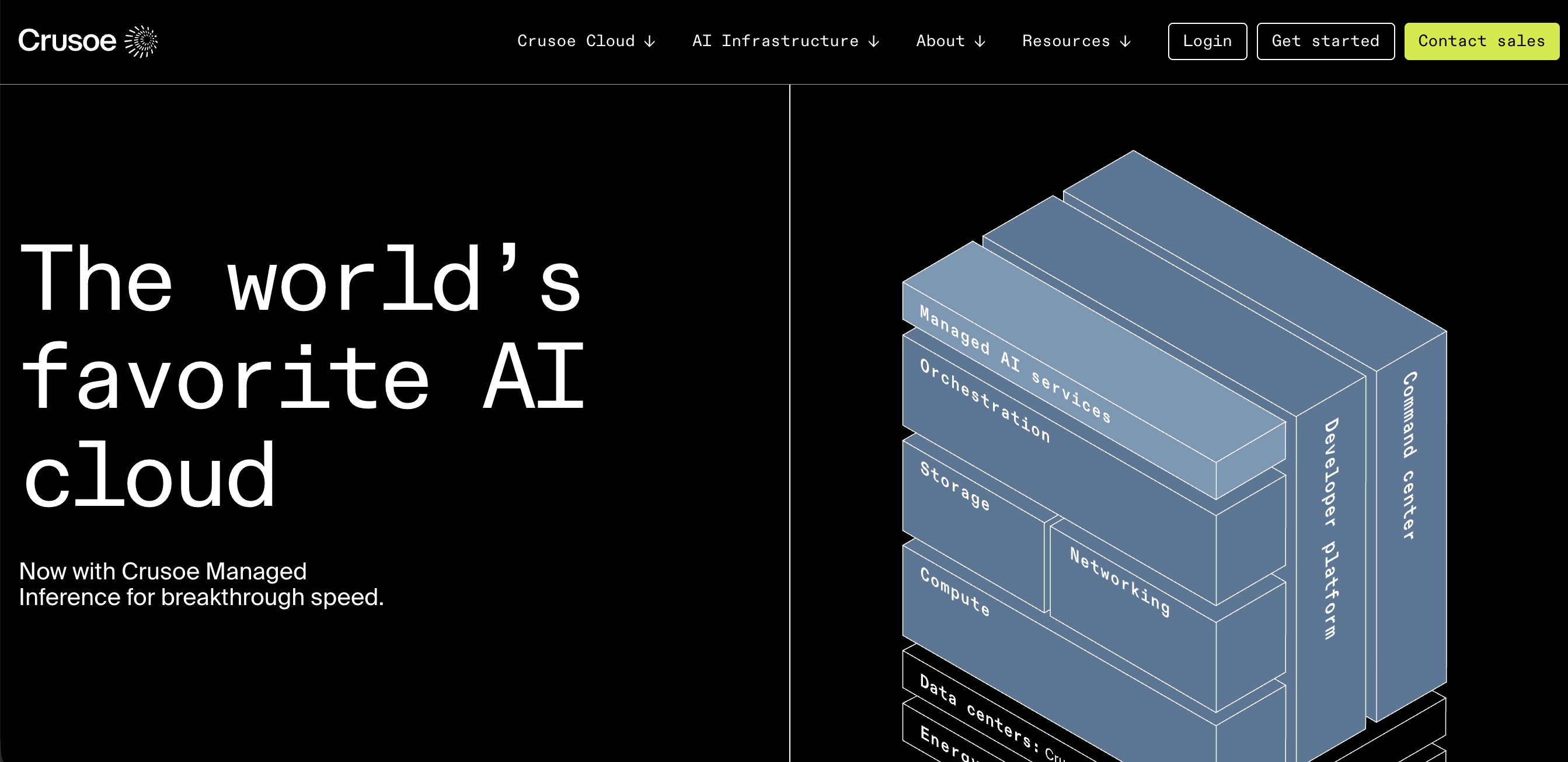
Crusoe Cloud is a purpose-built GPU infrastructure provider focused on large-scale AI model training. It delivers cluster-scale NVIDIA H100 environments optimized for distributed deep learning, high-bandwidth interconnects, and multi-node workloads. Unlike general-purpose hyperscalers, Crusoe prioritizes dedicated, large-block GPU provisioning for foundation model development. Its energy-optimized data centers strengthen its infrastructure-first positioning for AI-native companies and research teams training large models.
Crusoe Cloud key features:
-
Provisions tightly coupled GPU blocks within the same cluster fabric, improving topology efficiency and reducing cross-rack latency variability during large training runs.
-
Designed for sustained, high-utilization training cycles without preemption risk, making it suitable for multi-week foundation model training workloads.
-
Deploys infrastructure near underutilized or low-cost energy sources, helping organizations align large-scale AI compute with ESG and carbon-reduction goals.
-
NVIDIA H100 80GB: $3.90/GPU/hour
-
NVIDIA H200 141GB: $4.29/GPU/hour
6. Hyperstack with dedicated GPU capacity for AI training
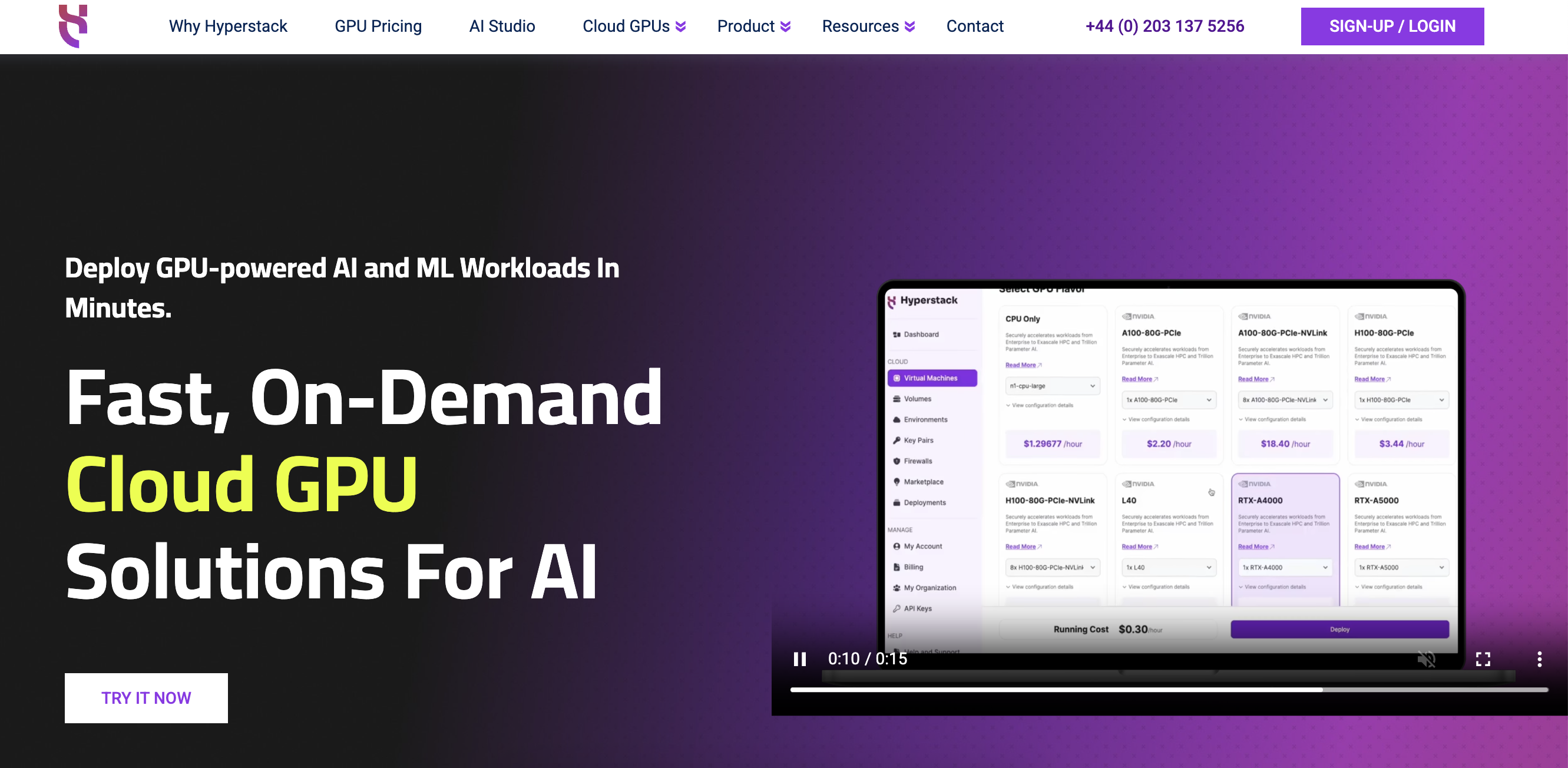
Hyperstack is a GPU-native cloud infrastructure provider purpose-built for AI training and large-scale inference workloads. Unlike general-purpose cloud platforms, it focuses specifically on delivering high-performance NVIDIA GPU environments optimized for deep learning and production inference pipelines. The platform provides scalable GPU capacity across global regions, enabling teams to provision single-GPU instances or expand into multi-node training clusters as model complexity increases. Hyperstack is built for organizations that need reliable GPU access and high performance for AI workloads. Its use cases include transformer training, generative AI, computer vision, and large-scale fine-tuning, helping teams iterate faster with consistent performance.
Hyperstack key features:
-
Capacity-first GPU allocation model designed to prioritize guaranteed availability of high-demand GPUs (H100/A100) rather than burst-only access, reducing training job preemption risk.
-
GPU lifecycle transparency (clear visibility into GPU generation and configuration), reducing ambiguity in accelerator allocation.
-
Deterministic bare metal provisioning workflows that avoid noisy-neighbor interference common in shared GPU clouds.
-
NVIDIA H100 SMX: $2.40/hour 80GB VRAM
-
NVIDIA H100: $1.90/hour
-
NVIDIA H200 SMX: $3.50/hour, 141GB VRAM
7. TensorDock with marketplace-based dedicated GPU servers
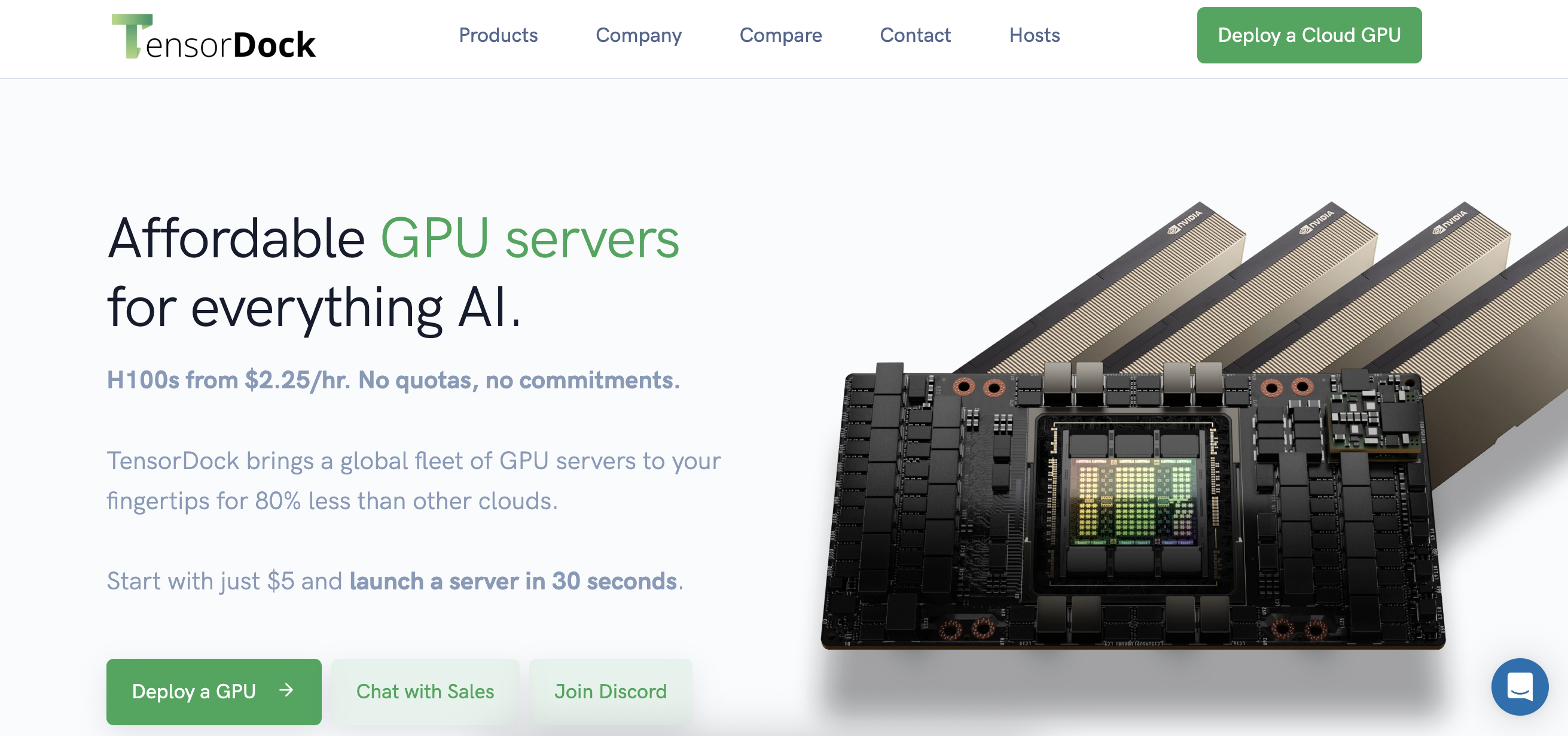
TensorDock is a distributed GPU cloud platform that aggregates compute capacity from multiple global providers into a single marketplace-style interface. It enables users to provision dedicated GPU servers on demand, making it easier to access high-performance compute without committing to hyperscaler contracts or long procurement cycles. The platform is particularly beneficial for AI startups, independent researchers, and mid-sized ML teams that need flexibility in hardware selection and cost control. Because users can choose from a range of GPU classes and geographic locations, TensorDock supports experimentation, short-term compute bursts, and iterative model development.
TensorDock key features:
-
Multi-operator infrastructure aggregation, meaning hardware is sourced from independent data center operators rather than a single centralized cloud fleet.
-
Granular hardware composability, enabling users to tailor CPU cores, RAM, disk, and bandwidth per server instead of selecting fixed instance SKUs.
-
Decentralized supply elasticity, where new GPU inventory enters the marketplace dynamically as providers list hardware.
-
Enterprise GPU H100: $1.99/hour
-
Workstation RTX GPUs: $0.20/hour- $1.15/hour
8. Voltage Park with distributed GPU clusters for foundation model training
Voltage Park provides high-performance GPU clusters designed specifically for large-scale AI model training. Rather than offering isolated GPU instances, it focuses on delivering tightly coupled multi-node environments capable of supporting distributed deep learning workloads. The platform is engineered for organizations building foundation models, training large transformer architectures, or running compute-intensive research pipelines. Voltage Park benefits teams that need consistent GPU cluster availability and high interconnect performance for multi-node training. It reduces the complexity of building distributed infrastructure by providing ready-to-scale GPU clusters. This makes it suitable for AI labs, enterprises building proprietary models, and startups developing LLMs or multimodal systems.
Voltage Park key features:
-
Minimal GPU fragmentation model, where capacity is provisioned in cohesive cluster units rather than piecemeal instance types.
-
Designed for long-running training cycles, prioritizing sustained cluster uptime over short-burst provisioning.
-
Pre-assembled large-scale GPU cluster blocks, reducing the need for customers to architect distributed training topology manually.
- On-demand H100: $1.99/hour
9. Vast.ai with decentralized GPU marketplace access
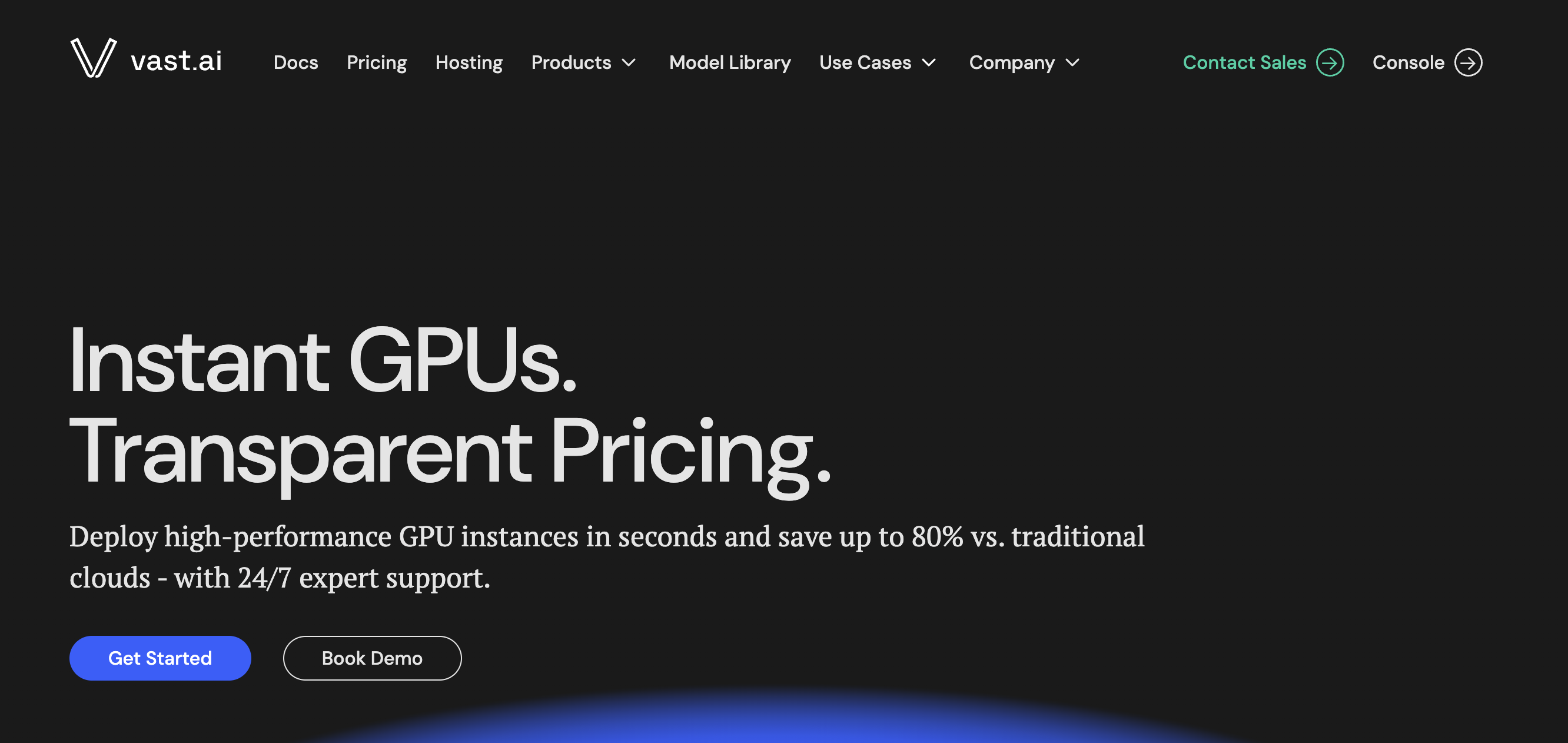
Vast.ai is a decentralized GPU compute marketplace that connects users with independent hardware providers offering GPU servers across the globe. Instead of operating centralized data centers, Vast.ai aggregates supply from individual operators, enabling users to select GPU hardware based on price, reliability, geographic location, and performance specifications. This marketplace model increases pricing transparency and expands access to high-end accelerators. The platform is ideal for startups, researchers, and ML practitioners looking for cost-efficient GPU access without long-term commitments. It supports fine-tuning, experimentation, batch training, and inference.
Vast.ai key features:
-
Decentralized bidding marketplace, where users can set maximum prices and allow hosts to compete for workloads.
-
Real-time supply-demand pricing dynamics, with visible cost variation based on GPU scarcity and regional availability.
-
Host-level reliability scoring system, incorporating uptime history and performance consistency metrics.
-
H100 SXM: $1.87/hr, P25
-
H200: $2.35/hr, P25
10. Together.ai with high performance LLM training and inference
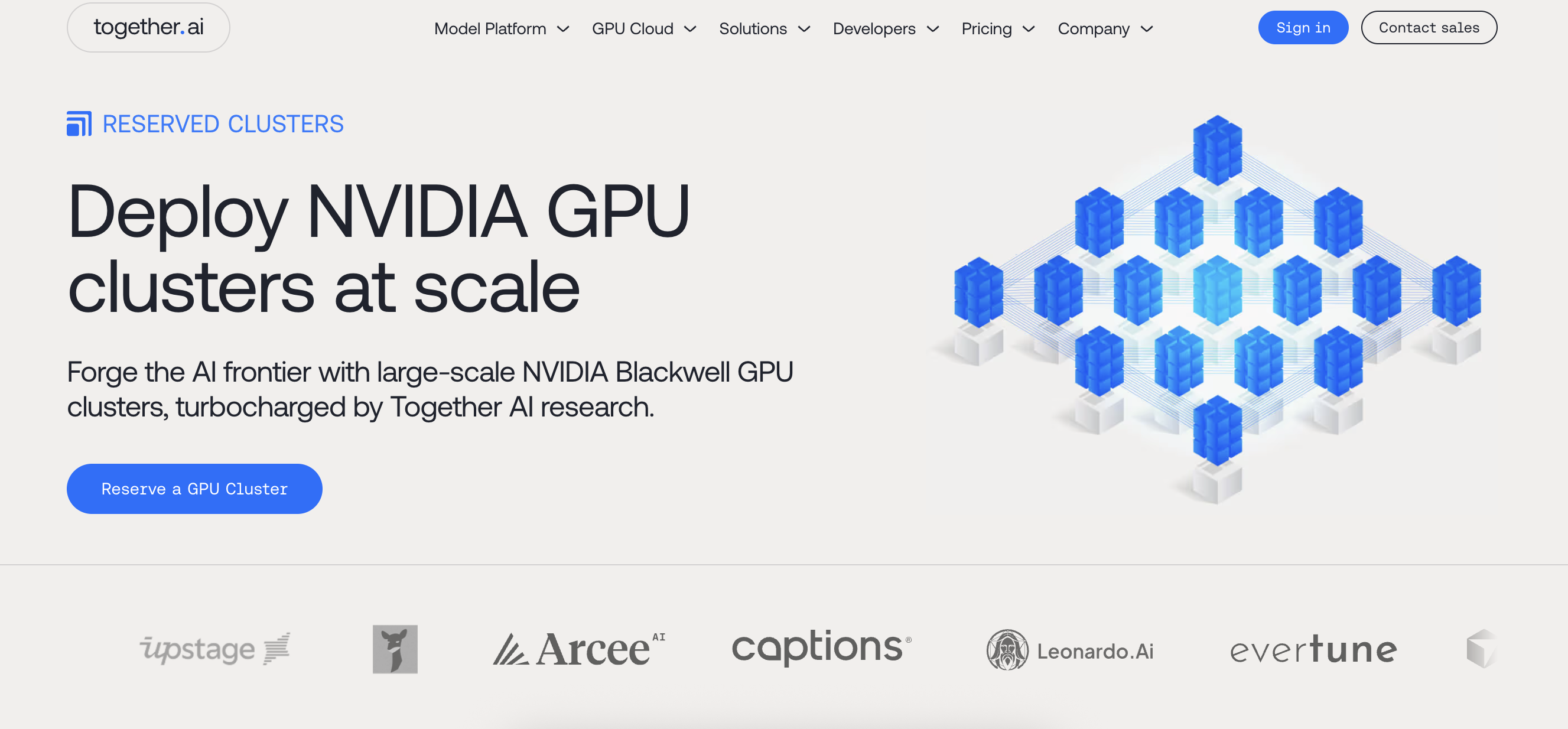
Together.ai operates an AI acceleration cloud designed for training and serving large language models at scale. It provides access to large, interconnected GPU clusters optimized for distributed workloads, enabling teams to run multi-node training jobs and high-throughput inference with strong performance consistency. With performance-optimized kernels and self-service cluster provisioning, Together.ai focuses on improving training speed and inference efficiency while reducing overall compute costs. It’s suitable for startups and research teams building frontier-scale models that require reliable, high-density GPU infrastructure.
Together.ai key features:
-
Frontier-scale cluster design supporting expansion from small deployments to tens of thousands of GPUs within the same architecture.
-
Rack-scale GPU systems with unified high-memory configurations, enabling large model shards to run with fewer cross-node bottlenecks.
-
High token-throughput batch inference infrastructure, designed for large-volume production inference rather than interactive API usage.
-
H100 SXM: $2.99/GPU/hour
-
H200: $ 3.79/GPU/hour
AI infrastructure companies FAQs
How does AI infrastructure differ from traditional cloud computing?
Traditional clouds handle general workloads, while AI infrastructure is optimized for high-performance GPU processing, low-latency networking, and scalability required for model training and deployment.
Which AI infrastructure company offers the best GPU availability in 2026?
It depends on each customer’s unique requirements, but DigitalOcean provides strong GPU availability through its GPU Droplets, offering access to both NVIDIA H100/H200 and AMD MI300X/MI325X options. With single-GPU and multi-GPU (including 8-GPU) configurations, DigitalOcean supports both on-demand provisioning and scalable production deployments. Availability varies by region, but the platform emphasizes predictable capacity, transparent pricing, and simplified provisioning for AI teams moving from experimentation to production.
Are there affordable AI infrastructure platforms for small teams?
Yes. DigitalOcean GPU Droplets are designed with predictable, pay-as-you-go pricing, making them accessible for startups, researchers, and small ML teams. The platform enables cost-controlled experimentation, fine-tuning, and short training runs without requiring long-term enterprise contracts. Clear pricing and simplified infrastructure management make it easier for smaller teams to manage GPU costs as workloads scale.
How do startups choose between hyperscalers and specialized AI clouds?
Hyperscalers offer deep integrations and worldwide infrastructure, but navigating their pricing models and operational complexity can be challenging for early-stage teams. Specialized AI clouds like DigitalOcean help startups stay efficient while still accessing the compute and AI tooling they need.
Which companies support fine-tuning and model hosting for LLMs?
Providers such as Together.ai focus on large-scale LLM training and high-throughput inference infrastructure. DigitalOcean GPU Droplets support fine-tuning and model deployment through flexible GPU instances, while platforms like RunPod and Lambda Labs enable custom model hosting in containerized environments. The right choice depends on whether teams need raw infrastructure control or cluster-optimized training environments.
What’s the best infrastructure for inference vs training workloads?
DigitalOcean supports both training and inference workloads through flexible GPU configurations and Kubernetes-compatible infrastructure. For training, multi-GPU Droplets and high-performance networking enable distributed model training and fine-tuning workflows, while for inference, GPU-backed deployments offer predictable hourly pricing, scalable capacity, and production-ready reliability—allowing teams to optimize for performance during training and cost efficiency during inference.
Accelerate your AI projects with DigitalOcean GradientTM AI GPU Droplets
Accelerate your AI/ML, deep learning, high-performance computing, and data analytics tasks with DigitalOcean GradientTMAI GPU Droplets. Scale on demand, manage costs, and deliver actionable insights with ease. Zero to GPU in just 2 clicks with simple, powerful virtual machines designed for developers, startups, and innovators who need high-performance computing without complexity.
Key features:
-
Powered by NVIDIA H100, H200, RTX 6000 Ada, L40S, and AMD MI300X GPUs
-
Save up to 75% vs. hyperscalers for the same on-demand GPUs
-
Flexible configurations from single-GPU to 8-GPU setups
-
Pre-installed Python and Deep Learning software packages
-
High-performance local boot and scratch disks included
-
HIPAA-eligible and SOC 2 compliant with enterprise-grade SLAs
Sign up today and unlock the possibilities of DigitalOcean GradientTM AI GPU Droplets. For custom solutions, larger GPU allocations, or reserved instances, contact our sales team to learn how DigitalOcean can power your most demanding AI/ML workloads.
Any references to third-party companies, trademarks, or logos in this document are for informational purposes only and do not imply any affiliation with, sponsorship by, or endorsement of those third parties.
About the author

Surbhi is a Technical Writer at DigitalOcean with over 5 years of expertise in cloud computing, artificial intelligence, and machine learning documentation. She blends her writing skills with technical knowledge to create accessible guides that help emerging technologists master complex concepts.
Start building today
From GPU-powered inference and Kubernetes to managed databases and storage, get everything you need to build, scale, and deploy intelligent applications.